← Explore all financial articles
Breaking Analysis · 18 min
Fed Raises Interest Rates in September 2026: What the 3.75%–4.00% Rate Means for Markets, Gold, the Dollar and Borrowers
Live Markets Editorial Team
Human-reviewed
Published: September 16, 2026
Last Updated: September 16, 2026
The Fed raised rates to 3.75%–4.00% on September 16, 2026. Here is what the unanimous decision, projections, market reaction, and borrowing costs mean.
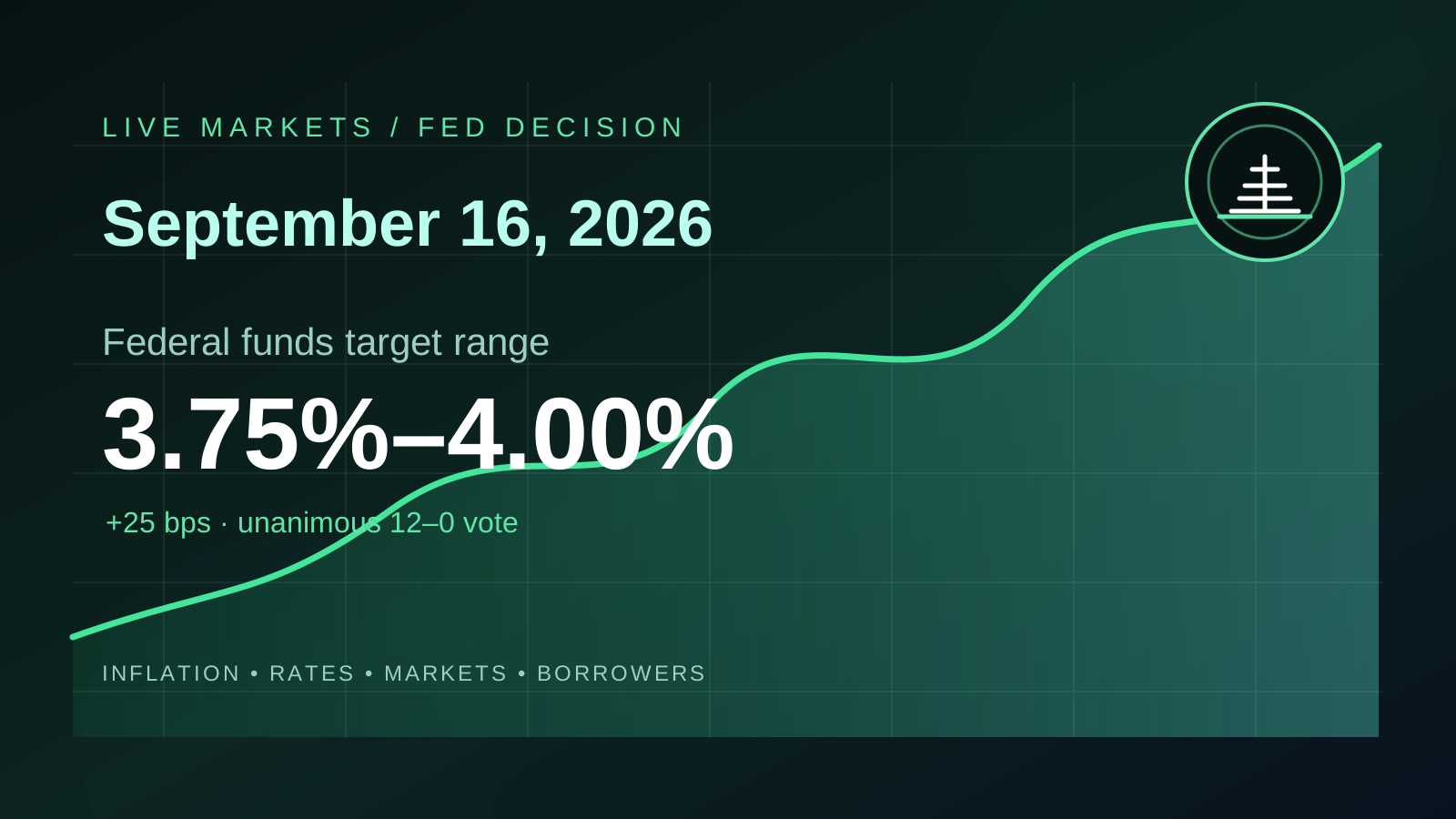
What the Federal Reserve decided on September 16, 2026
The Federal Open Market Committee raised the target range for the federal funds rate by one-quarter percentage point, moving it from 3.50%–3.75% to 3.75%–4.00%. The vote was unanimous at 12–0. This is a confirmed policy action, not a forecast: the new target range is the operating objective for overnight interest rates after the September meeting.
The accompanying statement kept the Fed's description of the economy constructive but cautious. Economic activity was expanding at a solid pace, domestic spending was resilient, productivity growth was strong, and capital investment was robust. Job gains had kept pace with the workforce and the unemployment rate had changed little. Against that backdrop, the committee judged inflation to be elevated and said the rate increase would support a timelier return of inflation to its 2% goal.
Why the Fed raised interest rates
The simplest explanation is that officials saw enough underlying demand and inflation persistence to justify more restraint even though employment was not deteriorating sharply. A central bank does not need a recession to raise rates. It can tighten when spending, productivity, investment, or financial conditions are strong enough to keep demand above the economy's near-term ability to supply goods and services without price pressure.
The statement's wording presents a deliberate trade-off. The economy is not described as collapsing, so the committee had room to focus on inflation. At the same time, the Fed did not claim that every inflation measure was moving in the right direction. Calling inflation elevated and emphasizing a timelier return to 2% signals that waiting for clear disinflation could carry a greater cost than accepting some additional restraint.
Why this rate hike matters
A move from 3.50%–3.75% to 3.75%–4.00% is small in isolation, but policy works through expectations and the entire interest-rate curve. The question for markets is not only where the overnight rate is today. It is whether investors now expect rates to stay high for longer, whether inflation risk deserves a larger premium, and whether the Fed will need to reverse course later if demand slows.
The increase also arrives alongside a September projection path that is higher than the June path in several years. That combination can be more important than the 25-basis-point move itself. A hike that markets already expected may cause little disruption; a hike paired with a more persistent rate outlook can lift Treasury yields, support the dollar, pressure long-duration equities, and reduce the appeal of non-yielding assets such as gold.
What Kevin Warsh said about inflation
In reporting on Chair Kevin Warsh's press conference, Reuters said Warsh described inflation as still too high and indicated that the summer readings had not convinced him that underlying trends had meaningfully improved. That is important because it frames the Fed's concern as persistence in the underlying process, not just one volatile monthly number.
The distinction between a single reading and a trend is central to monetary policy. Energy, goods, shelter, and other components can move unevenly, while services and wages can reveal whether inflation pressure is broadening or fading. Warsh's comments, as paraphrased and attributed by Reuters, suggest that the committee wants more evidence before treating recent readings as proof that inflation is returning smoothly to target.
September 2026 Fed projections: GDP, unemployment and inflation
The September Summary of Economic Projections gives the median participant assessment for the economy. The median real GDP growth projection is 2.3% for 2026, 2.4% for 2027, 2.2% for 2028, 2.1% for 2029, and 2.0% over the longer run. The unemployment-rate median is 4.1% in each year from 2026 through 2029, with a 4.2% longer-run estimate.
The inflation projections show more work ahead. Median headline PCE inflation is 3.7% in 2026, 2.3% in 2027, 2.1% in 2028, and 2.0% in 2029 and over the longer run. Median core PCE inflation is 3.4% in 2026, 2.5% in 2027, 2.2% in 2028, and 2.0% in 2029. These are the participants' forecasts under their individual views of appropriate policy; they are not a guarantee that inflation will follow the path.
The dot plot and what it suggests about future rates
The median projected appropriate federal funds rate is 4.1% for 2026, 4.1% for 2027, 3.9% for 2028, 3.6% for 2029, and 3.2% over the longer run. Read carefully, this does not say that the committee has pre-committed to those exact rates. It records where individual participants think policy should be if their economic outlook is correct.
The near-term median being above the new target midpoint indicates that participants, on balance, see restrictive policy continuing rather than an immediate sequence of cuts. The gradual decline later in the projection is consistent with inflation moving toward target over time. It is not a calendar promise, and the distribution of individual forecasts matters as much as the median when views are dispersed.
Why the new projections look more hawkish than June
The June median federal-funds-rate projections were 3.8% for 2026, 3.6% for 2027, 3.4% for 2028, and 3.1% over the longer run. September therefore lifted the median for 2026 and 2027 by 0.3 percentage point, the 2028 median by 0.5 point, and the longer-run median by 0.1 point. Those comparisons are one reason markets read the communication as more hawkish than the prior projection set.
The economic projections also changed in ways that provide context. The September median for 2026 GDP growth is 2.3%, compared with 2.2% in June, while the 2026 unemployment median is 4.1%, compared with 4.3% in June. Headline PCE inflation is 3.7%, compared with 3.6% in June, and core PCE inflation is 3.4%, compared with 3.3%. The 2027 and 2028 inflation medians also remain slightly higher in September.
Treasury yields react: the 10-year reaches 5%
At the time of Reuters' market report after the decision, the U.S. 2-year Treasury yield was about 4.734%, up about 7.07 basis points, while the 10-year yield was at 5%. Yields can move materially after a statement, press conference, auction, inflation release, or change in risk appetite.
The two-year sector is especially sensitive to expected policy over the next several meetings, so its rise is consistent with investors pricing a more persistent restrictive stance. The 10-year yield reflects more than the next rate decision: it includes expected future short rates, inflation risk, real growth, term premium, Treasury supply, and global demand for U.S. debt. A 5% ten-year yield can therefore tighten financial conditions even if the Fed pauses.
The U.S. dollar strengthens after the decision
Reuters reported the U.S. Dollar Index up 0.57% at 100.25 at the time of the market snapshot. The euro was down about 0.64% at $1.147, and the yen weakened about 0.47% to 155.99 per dollar. These moves describe the market at a particular reporting time, not a final daily settlement or a forecast of the next currency move.
A higher U.S. rate path can support the dollar by increasing the relative return available on dollar assets, particularly when other central banks are expected to ease or when investors seek liquidity. But exchange rates also respond to growth differentials, fiscal risks, trade policy, positioning, and risk sentiment. A hawkish Fed can lift the dollar in one episode and fail to do so in another if the policy message was already priced in.
Dollar strength matters globally because many commodities and debts are priced in dollars. A stronger dollar can make imported goods and external debt service more expensive for some economies, while reducing dollar revenue when local currency earnings are converted. The site's How the Dollar Affects Global Currency Markets framework helps separate the exchange-rate channel from the domestic fundamentals of each country.
Gold falls after the Fed announcement
Spot gold was down 1.19% to $4,241.59 per ounce in the Reuters snapshot. That is a time-stamped price and percentage move, and the market can change after publication. Gold does not pay a coupon, so higher real yields can increase the opportunity cost of holding it. A firmer dollar can also make dollar-priced gold more expensive for non-dollar buyers and weigh on demand at the margin.
The relationship is not mechanical. Gold can rise alongside yields when investors are concerned about fiscal credibility, geopolitical risk, currency debasement, central-bank purchases, or future inflation. The immediate decline therefore tells us how traders weighed the Fed's rate message against other forces at that moment; it does not prove that gold must fall whenever rates rise.
Investors comparing the move with fundamentals should watch real yields, the dollar, ETF flows, futures positioning, central-bank demand, and the inflation outlook. The site's Real Yields and Gold Prices and Gold as an Inflation Hedge: What the Evidence Shows guides provide useful context without turning one policy reaction into a permanent rule.
What the rate hike means for stocks
The Reuters market snapshot showed the Dow Jones Industrial Average down 1.3%, the S&P 500 down 0.69%, the Nasdaq Composite down 0.37%, and the MSCI global equities index down 0.52%. The different magnitudes are a reminder that an event can be negative for the broad market while affecting sectors and factors unevenly. These were market-reaction readings at the time of reporting and should not be treated as closing values unless explicitly identified as such.
Higher yields can pressure equity valuations by raising the discount rate applied to future cash flows. Long-duration growth companies are often more sensitive because more of their assumed value arrives far in the future. Banks and insurers may respond differently depending on funding costs, loan demand, credit losses, and the shape of the yield curve. Energy, defensives, exporters, and highly indebted businesses each have their own exposure.
The decision can also be read as a growth signal. The Fed's description of resilient spending and robust investment may support earnings expectations, even as the rate path raises the hurdle rate for valuation. The useful question is not simply whether stocks went down on the announcement. It is whether earnings revisions, credit spreads, breadth, and the curve continue to confirm a tighter financial-conditions regime.
What happened to Bitcoin and crypto
Bitcoin was down 0.22% to $75,729.93 in the Reuters snapshot. As with the other market figures, this was a time-sensitive reading rather than a guaranteed closing level. Digital assets can trade continuously, and their reaction to a central-bank decision can change quickly as liquidity, leverage, regulatory news, and broader risk appetite shift.
For analysis, separate the policy impulse from crypto-specific variables. Check spot and derivatives volume, funding rates, liquidations, stablecoin liquidity, exchange flows, and whether equities and high-yield credit are moving in the same direction. A small immediate move can conceal a larger repricing later if the rate path changes portfolio liquidity rather than the first reaction.
Oil above $100 and why energy matters to inflation
Brent crude settled down 2.69% at $105.83 per barrel in the supplied Reuters market report. Unlike the other intraday snapshots, this figure is identified as a settlement value in that report. Oil above $100 matters for inflation because energy enters household budgets directly and affects transportation, chemicals, manufacturing, and the cost of delivering goods.
The relationship between oil and monetary policy runs in both directions. A supply disruption can raise inflation while weakening real household income, creating a difficult trade-off for the Fed. Conversely, weaker demand can lower oil even while signaling a slowdown. The September decision therefore cannot be evaluated by the oil price alone; officials will watch whether energy moves pass through to broader prices and expectations.
Businesses and households should distinguish the direct fuel effect from second-round effects. A temporary crude spike may fade without changing wage or service inflation. A persistent move can influence expectations, margins, and consumption. That is why the committee's focus on underlying inflation trends remains important even when commodity prices are volatile.
What higher rates mean for mortgages
The federal funds target is not the mortgage rate, but it affects the environment in which mortgage rates are set. Fixed mortgage rates are more closely tied to longer-term Treasury yields, mortgage-backed-security pricing, lender margins, and expectations for future inflation and policy. A higher 10-year yield can therefore matter more for a new fixed mortgage than the 25-basis-point policy move by itself.
Adjustable-rate mortgages and home-equity lines can respond more directly when their reference rate resets. The timing depends on the contract, reset frequency, margin, caps, and floor. Borrowers should read the loan documents instead of assuming that a Fed move will pass through one-for-one. A higher rate also affects affordability by raising the payment for a given loan size, which can alter the price a buyer is able to offer.
The site's Fixed-Rate vs. Adjustable-Rate Mortgages and Mortgage Amortization: How Extra Principal Changes Interest and Payoff Time guides explain the mechanics. This is general education, not a recommendation to refinance, buy, or pay down a particular loan. The relevant comparison includes taxes, insurance, closing costs, liquidity, and the borrower's expected time in the property.
What higher rates mean for credit cards and other borrowing
Many credit cards use variable annual percentage rates tied to a benchmark, so their interest costs can adjust more quickly than a fixed-rate mortgage. A higher policy rate can therefore increase the monthly cost of carrying a balance, although the exact timing and margin are set by the card agreement. Auto loans, personal loans, and business credit may be fixed or floating, so the effect varies by product.
The most important household distinction is between the rate on new borrowing and the rate already locked in. A fixed-rate loan may not change, but refinancing or replacing it in a higher-rate environment can cost more. Variable debt can become more expensive without a new application. Borrowers should compare the effective APR, fees, reset rules, and payoff schedule rather than focusing on the headline policy rate.
The site's Credit Card APR, Interest, and Grace Periods guide explains why a grace period can prevent interest on purchases when the balance is paid in full, while revolving balances can compound at high rates. No generalized article can determine an individual's best repayment choice; the useful step is to understand the contract and protect emergency liquidity while reducing avoidable interest expense.
What higher rates mean for savings accounts and cash yields
Higher policy rates can improve the return available on cash, Treasury bills, money-market funds, and some savings accounts. The pass-through is not automatic. Banks set deposit rates based on competition, liquidity, loan demand, and their own funding needs. A large bank with abundant deposits may move its savings rate slowly even while short-term market yields adjust quickly.
Cash investors should compare the after-tax yield, access to funds, insurance or government backing, maturity, and reinvestment risk. A high current yield can fall when the policy path changes, while a locked certificate may trade liquidity for certainty. Inflation also matters: a nominal yield can be positive while the purchasing power of cash still declines.
The site's High-Yield Savings vs. Money-Market Accounts guide and Treasury Bills vs. Notes vs. Bonds comparison cover the differences. The Fed's hike is relevant to cash management, but it does not make every high-yield account or short-duration instrument interchangeable.
What the decision means for businesses
Businesses feel higher rates through revolving credit, floating-rate debt, refinancing, working capital, commercial real estate, and the discount rate applied to investment projects. A company with strong cash flow and a long debt maturity may feel little immediate pressure. A highly leveraged company with near-term maturities may face a much larger change in interest expense.
The Fed statement's references to strong productivity and robust capital investment provide a constructive macro backdrop, but they do not remove financing risk. A higher hurdle rate can cause management teams to delay marginal projects, negotiate harder with suppliers, or prioritize cash preservation. Small businesses may face tighter bank underwriting even if the policy rate changes by only 25 basis points.
What the decision means for emerging-market currencies
A stronger dollar and higher U.S. yields can create pressure for emerging-market currencies, especially where external debt is dollar-denominated or foreign investors are important holders of local bonds. Dollar debt service becomes more expensive in local-currency terms, and investors may demand more compensation to hold riskier assets when U.S. cash and Treasuries offer higher yields.
The site's Emerging Market Currencies and Dollar Strength guide provides a framework for separating global dollar pressure from local fundamentals. For a dollar-linked economy, the exchange rate may be stable while domestic interest rates and liquidity absorb the shock. The Saudi Riyal 2026 analysis is a useful example of how a peg changes the transmission mechanism.
What it could mean for the euro, yen and dollar-linked currencies
The euro and yen are especially sensitive to expected interest-rate differentials, but those differentials are only one part of the exchange rate. Growth, fiscal policy, trade, energy costs, and central-bank reaction functions matter too. The Reuters snapshot showed the euro lower and the yen weaker against the dollar, consistent with a short-term repricing toward the U.S. side of the rate differential.
Dollar-linked currencies can have a different experience. A peg or managed band may limit the spot-rate move, but the local central bank may need to keep domestic money-market conditions aligned with the dollar or accept capital-flow pressure. The cost can appear in local lending rates, reserves, or financial conditions rather than in a large currency move.
The proper analysis is therefore cross-market. Watch the dollar index, front-end yield spreads, forward points, central-bank communication, reserves, and local inflation. A single day of currency appreciation or depreciation is evidence about positioning and expectations at that moment, not proof that a country's long-run currency value has changed.
Implementation mechanics: what changed behind the headline
The September 16 implementation note said the interest rate paid on reserve balances would rise to 3.90%, effective September 17. It also set the standing overnight repo rate at 4.0%, the standing overnight reverse repo offering rate at 3.75%, and the primary credit rate at 4.0%. These operating rates help anchor money-market transactions around the new policy stance.
The note also continued the ample-reserves framework, under which the New York Fed's Open Market Desk can conduct transactions to maintain an ample level of reserves. Ordinary readers do not need to follow each operation to understand the decision. The practical point is that the Fed changed the overnight-rate corridor and retained the tools used to keep short-term funding markets orderly.
What investors and households should watch next
The first watch item is inflation, especially whether core services and other underlying measures are moving consistently toward 2%. One favorable month will not settle the question. The second is employment: stable unemployment and job gains that keep pace with the workforce give the Fed more room to prioritize inflation, while a clear labor-market deterioration would change the policy trade-off.
The third is financial conditions. Watch two-year and ten-year Treasury yields, the curve, credit spreads, mortgage rates, the dollar, equity breadth, and funding-market stress together. A rate hike can have a larger economic effect if these markets tighten in concert. Conversely, a strong risk rally and easier credit can offset some of the intended restraint and may keep officials cautious.
Households can monitor their own exposure rather than trying to forecast the next meeting. List fixed and variable debts, upcoming resets, cash yields, refinancing dates, and emergency liquidity. Investors can review duration, leverage, concentration, and the assumptions embedded in valuations. These are risk-management steps, not individualized investment advice or a prediction about any particular asset.
Upcoming Fed decisions and economic data that matter
The next policy decision will be shaped by the data available between meetings and by how officials interpret the cumulative evidence. Inflation reports will test whether the 2026 PCE and core PCE projections are plausible. Employment reports will test the 4.1% unemployment median. Spending, income, productivity, housing, credit, and business surveys will show whether the solid-activity description is persisting.
Market participants should also watch revisions. Economic data are not static, and later revisions can change the picture that policymakers thought they were seeing in September. Treasury auctions and term premiums matter because a higher long-term yield can tighten conditions without a change in the federal funds target. Oil and other supply shocks can move inflation while weakening demand, complicating the signal.
Bottom line
The September 16, 2026 decision was a confirmed 25-basis-point increase to a 3.75%–4.00% federal funds target range, approved unanimously by 12 FOMC voters. The Fed described an economy with solid activity, resilient spending, strong productivity, robust investment, and a relatively stable labor market, but it also said inflation remains elevated and that policy should support a timelier return to 2%.
The September projections were more restrictive than June's rate path, while still describing continued growth and unemployment near 4.1%. The most important message is conditional persistence: officials appear willing to keep policy restrictive until the inflation trend is convincing, but their projections are not promises. The immediate market reaction—lower stocks and gold, higher Treasury yields and the dollar, and a modestly lower Bitcoin—shows how investors translated that message at the time of reporting.
For borrowers, the decision can raise the cost of variable debt and influence mortgage and business financing through the broader yield curve. For savers, it can support better cash yields, though pass-through varies. For global markets, a stronger dollar and higher U.S. yields can tighten conditions unevenly. The next phase will be determined by data, expectations, and whether financial conditions reinforce or offset the Fed's intended restraint.
Methodology and source note
Policy facts in this article come primarily from Federal Reserve releases: the September 16 FOMC statement, the September Summary of Economic Projections, and the implementation note. Market-reaction figures are time-stamped snapshots from reputable Reuters reporting and are labeled as snapshots or settlement values where appropriate. Market prices can change after publication.
The projections are individual FOMC participants' assessments of appropriate monetary policy under their own economic outlooks. They are not guarantees, promises, or a fixed schedule. This article separates confirmed policy facts, Fed projections, reported market reaction, and Live Markets analysis. It is educational information, not individualized investment, tax, legal, or financial advice.
Sources / References
- Federal Reserve FOMC Statement — September 16, 2026 — Board of Governors of the Federal Reserve System — Primary source for the unanimous decision, target range, economic assessment, and 2% inflation goal.
- Summary of Economic Projections — September 16, 2026 — Board of Governors of the Federal Reserve System — Primary source for median GDP, unemployment, inflation, and federal-funds-rate projections.
- Federal Reserve Implementation Note — September 16, 2026 — Board of Governors of the Federal Reserve System — Primary source for reserve-balances, repo, reverse-repo, and primary-credit operating rates.
- Global markets wrapup — September 16, 2026 — Reuters — Secondary reporting for the time-stamped cross-asset market reaction.
- Warsh says Fed focus to stay on inflation — Reuters — Secondary reporting for the attributed paraphrase of Chair Kevin Warsh's inflation comments.